This article is part of a series.
- The Cyber Crime Awareness Series – What You Don’t Know Can Hurt You
- Part 1: Cyber Crime is Booming in Australia
- Part 2: Don’t Click That Link!
- Part 3: Digital Arrests, Loan App Blackmail & High-Stakes Scams Targeting Australians
- Part 4: Your OTP Isn’t Safe
- Part 5: The Price of Free
- Part 6: Inside the Dark Web
- Part 7: Digital Detectives
- Part 8: Cyber Security Toolkit
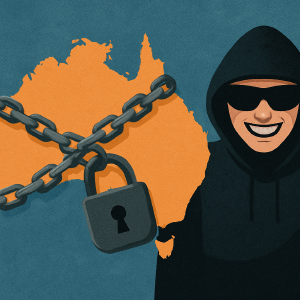
🦹 Cyber Crime is Booming in Australia: Are You on the Target List?
💤 A Personal Wake-Up Call
I’ll admit — I used to think cyber crime was something that only happened to people who clicked on obviously dodgy emails or reused the password 123456 across every site. That illusion shattered when a colleague — tech-savvy, cautious, and a regular reader of cyber security news — lost $9,000 in a sophisticated SMS phishing scam that mimicked her bank so convincingly, she didn’t even blink before clicking the link.
That was my wake-up call. Since then, I’ve been diving deeper into cyber security — professionally and personally — and what I’ve learned is this: cyber crime doesn’t discriminate. If you’re online (and who isn’t?), you’re on the target list.
🤔 Cyber Crime in Australia: Bigger Than You Think
According to the Australian Cyber Security Centre (ACSC), over 94,000 cyber crimes were reported in 2022–23, with an attack logged every 6 minutes1. That’s just what’s officially reported — experts believe the real number is far higher, because many incidents go unreported due to embarrassment or not knowing who to contact.
The impact? Estimated losses are now over $3 billion annually, affecting everything from individuals losing life savings to SMEs struggling to recover from ransomware attacks. The most targeted sectors include health, education, financial services, and local councils — but individuals like you and me make up the bulk of victims.
💀 Who’s Really at Risk? (Spoiler: All of Us)
Forget the stereotype that only elderly or “non-techie” people fall for scams. Cyber criminals are clever — they craft messages that play on human emotion: urgency, fear, curiosity, greed, love.
Here’s who’s at risk in the real world:
- University students falling for fake job offers.
- Busy professionals clicking links during rushed lunch breaks.
- New parents buying discounted baby gear from scam websites.
- Investors tempted by fake crypto returns.
- Elderly Australians manipulated via phone calls impersonating the ATO or police.
If you’ve ever clicked a QR code on a parking meter, shared your location with a food delivery app, or installed a “free” game, you’ve already created a digital trail that criminals could exploit.
🙆♂️ The Human Weakness: Lack of Awareness
When I started my deep dive into cyber security, one thing stood out: most people don’t know what they don’t know.
A 2023 Norton Cyber Safety report found that 37% of Australians reuse passwords across critical accounts2. Worse, many don’t even enable Two-Factor Authentication (2FA) on platforms like email or banking apps — the digital equivalent of leaving your front door unlocked.
Even tech professionals — yes, even those working in government or enterprise IT — have fallen victim due to overlooked basics. That’s why awareness isn’t optional anymore — it’s essential.
💀 The Common Threats We’ll Dive Into
This blog series aims to unpack the most common (and dangerous) scams Australians face, using real cases, industry insights, and lessons learned from my own experiences in the cyber security space.
Here’s a quick preview:
- Digital Arrest Scams: You receive a call saying you’re under investigation by the AFP or ATO. Panic sets in. You start following their instructions. This scam is terrifying — and far more common than you’d think.
- QR Code Scams: That quick scan for a menu or parking app could reroute your payment or infect your device.
- Phishing Links: Often disguised as Australia Post tracking messages, tax returns, or MyGov alerts.
- Fake Loan Apps: Apps offering quick cash but stealing your contacts and photos.
- Blackmail via Morphed Images: Victims are targeted using deepfakes or AI-enhanced images — even without their consent.
In each post, I’ll explain how these scams work, share examples from real incidents (including some lesser-known ones), and offer tips on how to spot the red flags before it’s too late.
🚨 Cyber Crime is Changing the Nature of Crime in Australia
What’s even more disturbing is how cyber crime is now facilitating traditional crime. In NSW, cyber tools are being used for intimidation, extortion, stalking, and even aiding organised crime groups. According to the Australian Federal Police, cyber investigations often now overlap with criminal investigations into money laundering, drug trafficking, and even human trafficking.
In short: cyber space is becoming the new battleground — and ordinary Australians are being caught in the crossfire.
👍 What You Can Do (Starting Now)
While the threats are real, the good news is that you can take control. Start by:
- Using strong, unique passwords (a password manager helps).
- Enabling 2FA on email, banking, and government portals like MyGov.
- Being sceptical of links, QR codes, and apps you don’t trust.
- Learning how to spot social engineering red flags.
- Talking about cyber safety with your family — yes, even your kids and parents.
In later posts, I’ll also recommend tools like Mobi Armour and HaveIBeenPwned, and show you how to report incidents quickly and effectively.
🙈 Final Thoughts: No One is Too Smart to Be Scammed
I’ve worked with people who built entire DevOps pipelines, coded in six languages, and managed cloud infrastructure — and still got hacked because they trusted the wrong link. That’s not stupidity. That’s being human.
The goal of this series is to make cyber awareness second nature — for everyone from tradies to techies, retirees to teenagers. If you learn even one thing that helps you avoid a scam or secure your data, this post has done its job.
Stay with me — next week, we’ll dive into the subtle but deadly world of QR codes, phishing links, and social engineering tricks.
📚 References
Australian Cyber Security Centre. (2023). Annual Cyber Threat Report 2023–24. Retrieved from https://www.cyber.gov.au/about-us/view-all-content/reports-and-statistics/annual-cyber-threat-report-2023-2024 ↩︎
NortonLifeLock. (2023). Cyber Safety Insights Report: Australia Edition. Retrieved from https://au.norton.com ↩︎
This article is part of a series.
- The Cyber Crime Awareness Series – What You Don’t Know Can Hurt You
- Part 1: Cyber Crime is Booming in Australia
- Part 2: Don’t Click That Link!
- Part 3: Digital Arrests, Loan App Blackmail & High-Stakes Scams Targeting Australians
- Part 4: Your OTP Isn’t Safe
- Part 5: The Price of Free
- Part 6: Inside the Dark Web
- Part 7: Digital Detectives
- Part 8: Cyber Security Toolkit
comments powered by Disqus